


Free Car Accident Consultation: What to Expect and Bring
A free car accident consultation costs nothing and commits you to nothing. See what happens in the meeting,…
Read moreCall For A Free Consultation
Menu

If a car has hit you on your bike, your health comes first and your claim comes second, but the claim starts at the scene. What you document, what you say and how quickly you act all shape what an insurance company later offers. A bicycle injury attorney can take the claim off your hands while you recover. At Select Law, we represent injured cyclists on a contingency basis, which means no fee unless we win, and your first consultation and case evaluation are free.
This guide covers the steps to take after a crash, how fault is decided, what compensation can include, what happens when the driver flees or has no insurance, and the filing deadlines in Washington and Arizona.
The first hour matters most, both for your body and for your evidence. Work through these steps as far as your injuries allow, and ask a bystander to help if you cannot.
Our page on the steps to take after a car accident to file an injury claim walks through the same early decisions in more detail.
Leaving after a crash that injures someone is a crime, not an accident. Florida’s highway safety agency, for example, notes that fleeing a crash with a fatality can bring up to 30 years in prison and a $10,000 fine under that state’s law. Penalties differ by state, but the practical lesson is the same everywhere: report it immediately.
If you can, note the car’s color, make, partial plate, direction of travel and any damage it would have. Ask witnesses what they saw. Then call 911 and tell us, because early footage and canvassing of nearby cameras can identify a driver.
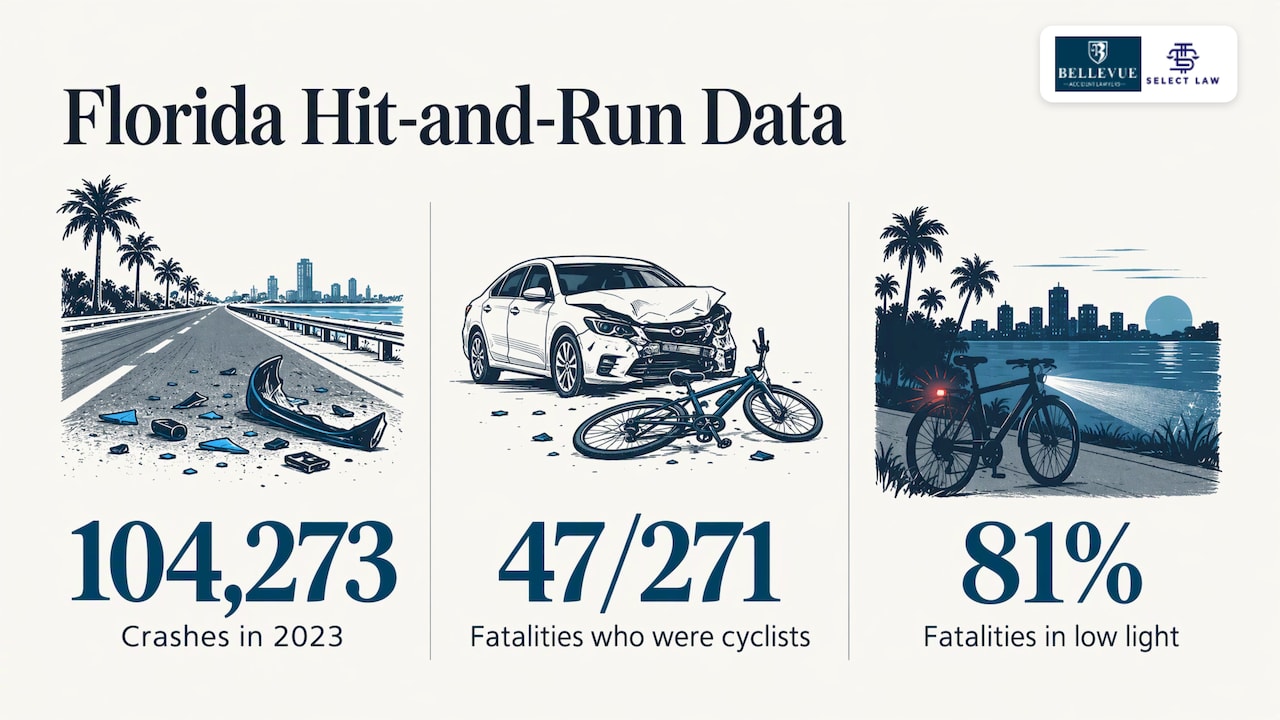
Hit-and-run is not rare for cyclists. In 2023, Florida recorded 104,273 hit-and-run crashes, and 47 of the 271 hit-and-run fatalities were bicyclists. The same agency reports that 81% of those fatalities happened at dawn, dusk or in low light, which is a reason to treat early-morning and evening rides as higher risk and to keep lights on your bike.
Fault decides who pays. In most injury claims it turns on negligence: whether the driver failed to use reasonable care and whether that failure caused your injuries. Typical driver errors in bike crashes include:
The evidence that proves these things is the evidence from the steps above: the police report, photos, witness statements, video, vehicle damage and medical records. Crash reconstruction can add to it in serious cases.
Insurers frequently argue that the cyclist was riding in the wrong place, wore no helmet, had no lights or was hard to see. States treat shared fault differently, and in many states a rider who is partly responsible can still recover compensation, reduced by their share. The details depend on the state where the crash happened, so the rule that applies to you should be confirmed with an attorney before you accept any blame in a statement.
Helmet use is a common point of dispute. Our article on seatbelt and helmet use in injury claims explains how it can be raised in Arizona and why not wearing one does not automatically end a case.
The same approach applies to pedestrians and riders hit in marked crossings. If your crash happened in a crosswalk in Oregon, see what to do after being hit in a crosswalk in Oregon.
A cyclist has no steel frame around them, so injuries from even a moderate-speed impact tend to be serious: fractures, road rash and scarring, concussions and other head injuries, and spinal damage. A claim generally seeks to cover two kinds of loss.
| Type of loss | Examples |
|---|---|
| Economic | Ambulance and hospital bills, surgery, physical therapy, prescriptions, future medical care, lost wages, reduced earning capacity, bike and gear replacement |
| Non-economic | Pain and suffering, scarring and disfigurement, loss of enjoyment of life, emotional distress |
The value of any claim depends on your injuries, the medical costs, how long you recover, and how clearly fault can be shown. We do not promise a number, and no honest attorney can before the full extent of your injuries is known. That is why settling early is risky: a quick offer usually arrives before you know whether you need surgery or long-term care.
If your crash left lasting marks, those losses count too. We handle claims for head injuries and scars as part of our personal injury work.
More than one policy may be involved:
These layers are why a cyclist’s claim is rarely a single phone call. Each insurer has its own deadlines and notice requirements, and your own insurer can contest what you are owed under your own policy.
A driver with no insurance, or one who disappears, does not always leave you without recourse. Washington, for instance, requires new and renewed auto liability policies to offer underinsured, hit-and-run and phantom-vehicle coverage, subject to exceptions. A phantom vehicle is one that cannot be identified, such as a hit-and-run car. Arizona’s statutes also address uninsured and underinsured motorist claims and their time limits in Title 12 of the Arizona Revised Statutes, at section 12-555.
This coverage often applies to you as a cyclist, not only when you are in a car, but the policy’s wording and its notice requirements matter. Our video on recovering damages after being hit by an uninsured or underinsured driver in Washington explains how these claims work. We also handle claims where the other side’s insurer refuses to deal fairly, including insurance bad faith.
Every state sets a statute of limitations, which is the deadline to file a lawsuit. Miss it and your right to sue is usually gone, however strong the case. For the states where we have offices:
| State | Deadline for most personal injury suits | Source |
|---|---|---|
| Washington | Three years | RCW 4.16.080 |
| Arizona | Two years from when the claim accrues | A.R.S. 12-542 |
| Oregon | Confirm with an attorney, since the deadline depends on the facts of your claim | None |
These are the general rules, and exceptions can shorten or extend them. Insurance policies also set their own notice deadlines for uninsured motorist and similar claims, and these can be much shorter than the lawsuit deadline. Claims against a city or other government body, for example for a dangerous road defect, often have special notice rules. If your crash involved any of these, speak with us as soon as possible.
Oregon has also changed a rule that matters to riders on trails and other land open to the public. Oregon Laws 2025, chapter 220 amended the statutes on landowner immunity for bicyclists and other non-motorized users, effective January 1, 2026, and it preserves claims for gross negligence and reckless or intentional misconduct. If you were hurt on a trail rather than a road, that law may apply to you.
When a crash takes someone’s life, the family faces grief and financial strain together. A wrongful death claim lets a representative of the estate seek compensation for the family from the party responsible. In Washington, a representative can sue within one year after a claimant’s death if the cause of action survives, and in Arizona, a claim for an injury when death ensues must be started within two years. Who may file and what can be recovered differ by state.
A criminal case, such as a hit-and-run or DUI prosecution, runs separately from a civil claim, and its outcome does not replace compensation for the family. Our wrongful death team can explain the options at a time when you need clear information and not pressure.
A cyclist faces three problems an insurance adjuster knows well. The first is timing: early offers come before the full cost of recovery is clear. The second is fault: bike crashes invite arguments about visibility, positioning and helmets. The third is coverage: with several policies in play, it is easy to miss one.

An attorney deals with these in parallel. We gather the police report, medical records, video and witness statements, handle communication with the insurers, work out the full value of your losses and, if the claim does not settle fairly, file a lawsuit before the deadline. You focus on healing.
At Select Law, you speak directly with an attorney and get personal attention, and our fee is contingent: you owe nothing unless compensation is won. Our firm has been voted the Best Personal Injury Law Firm.
Safety policy is also moving. Congress has before it H.R. 3649, the Magnus White Cyclist Safety Act of 2025, which would direct the Secretary of Transportation to issue rules on automatic emergency braking systems in new covered vehicles. Until rules like that change the roads, a claim is how an injured rider recovers losses.
We represent cyclists injured by drivers from our offices in Bellevue, WA, Scottsdale, AZ and Lake Oswego, OR. Read about our bicycle accident representation, or contact Select Law for a free consultation and case evaluation. There is no fee unless we win.
If you are in the Phoenix area, our Maricopa County personal injury page covers local details.
Most cyclists we meet did something right: they rode where they were allowed, and a driver did not look. What turns that into a hard claim is what follows, an insurer that frames the crash as the rider’s problem, a bill that arrives before the doctor knows the full injury, and a deadline nobody mentioned.
We believe an injured rider should be able to talk to the attorney handling the case, not a rotating cast of staff. That is how we work: direct communication, personal attention and clear guidance about each decision, from what to say to the adjuster to whether an offer reflects the injury.
We also believe the cost of hiring a lawyer should never be the reason someone goes without one. Our fee is contingent, so you owe nothing unless we win, which lets you focus on recovery and not on legal bills.
select
The driver is generally required to stop, check on the rider and share information, and police may investigate. Leaving the scene can bring criminal charges, which vary by state. Separately, the rider can bring a civil claim against the driver’s insurance for medical bills, lost income and pain and suffering.
An admission at the scene helps, but it does not set the value of your claim or stop the insurer from disputing it later. An attorney documents your full losses and handles negotiations so you are not pressured into an early, low settlement. Our consultation is free, and we charge nothing unless you win.
That can be raised by the insurer, but it does not automatically end your claim. How it affects recovery depends on the state’s rules and the facts of your crash. Tell us the details at your free consultation, and we will explain where you stand.
In Washington, most personal injury suits must be filed within three years. In Arizona, the limit is two years. Insurance policies and claims against government bodies can have shorter deadlines, so contact us as soon as you can.
Often, yes. Your own underinsured, uninsured or hit-and-run coverage may apply, and Washington requires such coverage to be offered on auto liability policies, subject to exceptions. The terms of your policy decide the details, so we review it with you.
Written with BabyLoveGrowth to get found on Google
A free car accident consultation costs nothing and commits you to nothing. See what happens in the meeting,…
Read more
What dog bite compensation can cover, who pays, how the claim and settlement process works, and the deadlines…
Read more
Hurt in a motorcycle crash in Portland? Learn what to do first, how Oregon insurance rules affect your…
Read more
Parham Hakimi is the founder of Select Law. Parham is passionate
about helping clients get a fresh start and victims who have
been wronged by the acts of others... Read more


