

Pedestrian Accident Lawyer: What They Do and When to Call
Hit by a car as a pedestrian? Learn what a pedestrian accident lawyer does, how fault and fees…
Read moreCall For A Free Consultation
Menu
A hotel injury lawyer builds the one thing a guest cannot build alone: proof that the hotel knew, or should have known, about a danger and did not fix it or warn you. Hotels are not responsible for every fall or accident on their property. They are responsible when they fail to use reasonable care. At Select Law, our attorneys handle premises liability and slip and fall claims from our offices in Bellevue, WA, Scottsdale, AZ and Lake Oswego, OR, and we offer free consultations and case evaluations. We work on a no fee unless we win basis, so you carry no legal bills while you recover.
Hotel injury claims are a type of premises liability: the law that makes property owners answer for dangerous conditions on their land. Courts across the country start from the same idea. A hotel is not an insurer of your safety, but it must act reasonably.
The California Supreme Court put it this way in Peterson v. Superior Court (1995): a hotel is not an insurer of guest safety, but it can be liable under ordinary negligence principles when it breaches the standard of care for premises defects. The Minnesota Supreme Court said something similar earlier, in Connolly v. Nicollet Hotel (1959): a hotel must take reasonable precautions against foreseeable risks, and whether its precautions were enough is ordinarily a question for the jury.
In practice, that covers a wide range of situations:
That last example comes from Phelps v. Hotel Management (Oklahoma Supreme Court, 1996), where the court held that whether a displayed glass bowl was an open and obvious danger could be a question of fact, because its placement might look harmless while still posing a risk.
Negligence is the legal term for failing to use reasonable care. State laws differ in wording, but a hotel injury claim generally rests on the same elements. In its 1996 Motel 6 v. Lopez decision, the Texas Supreme Court set them out for a guest’s premises claim:
The knowledge element is where many claims are won or lost. The Ninth Circuit explained in Petrey v. Princess Cruise Lines (April 2026) that a claimant ordinarily must show actual or constructive notice of the dangerous condition. It also noted that proving the defendant created the condition shows it knew the condition existed, but does not automatically show it knew the condition was unreasonably dangerous. That case arose under maritime law, so treat it as an illustration of how courts reason about notice, not as the rule in your state.
Courts require an identifiable cause. In Aalbers v. LaSalle Hotel Properties (Illinois Appellate Court, 2022), the court explained that a plaintiff must show proximate causation with reasonable certainty, and that simply falling on hotel premises does not establish negligence without proof of a condition that caused the fall.
This is why the first hours matter. If you cannot say what you slipped on, what was missing, or what was broken, the hotel’s insurer will say nobody can know whether the hotel did anything wrong.
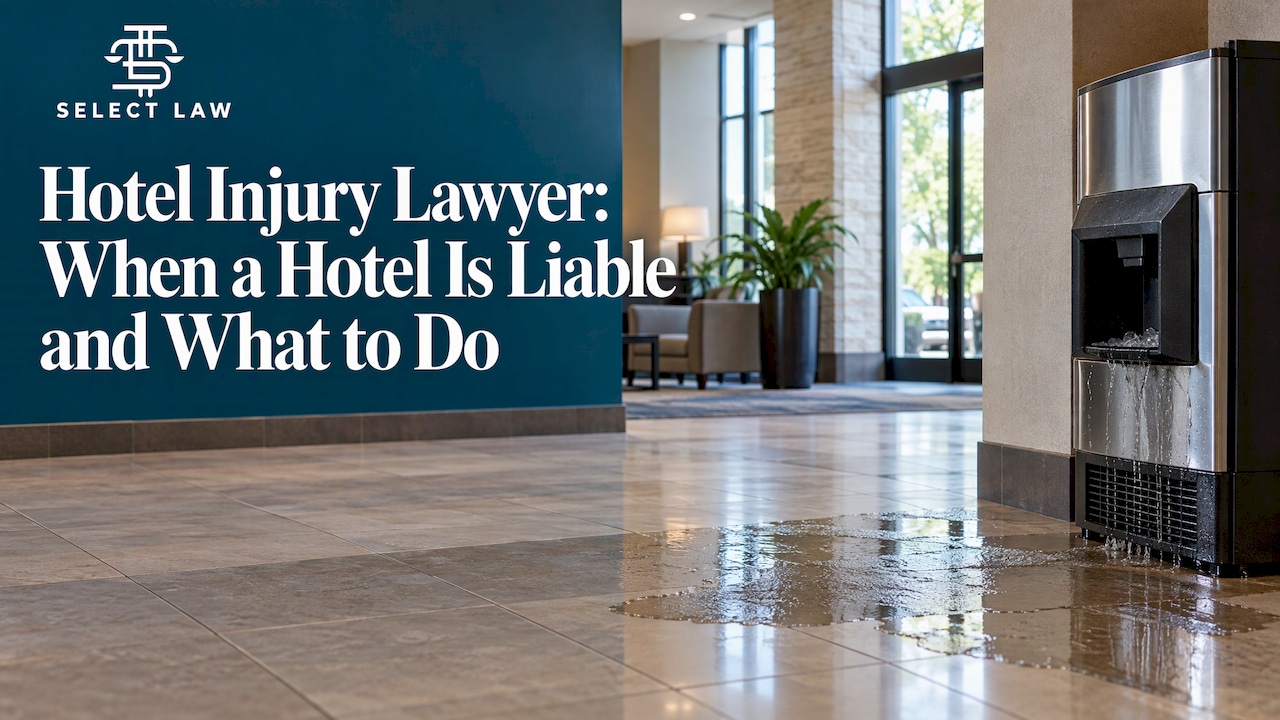
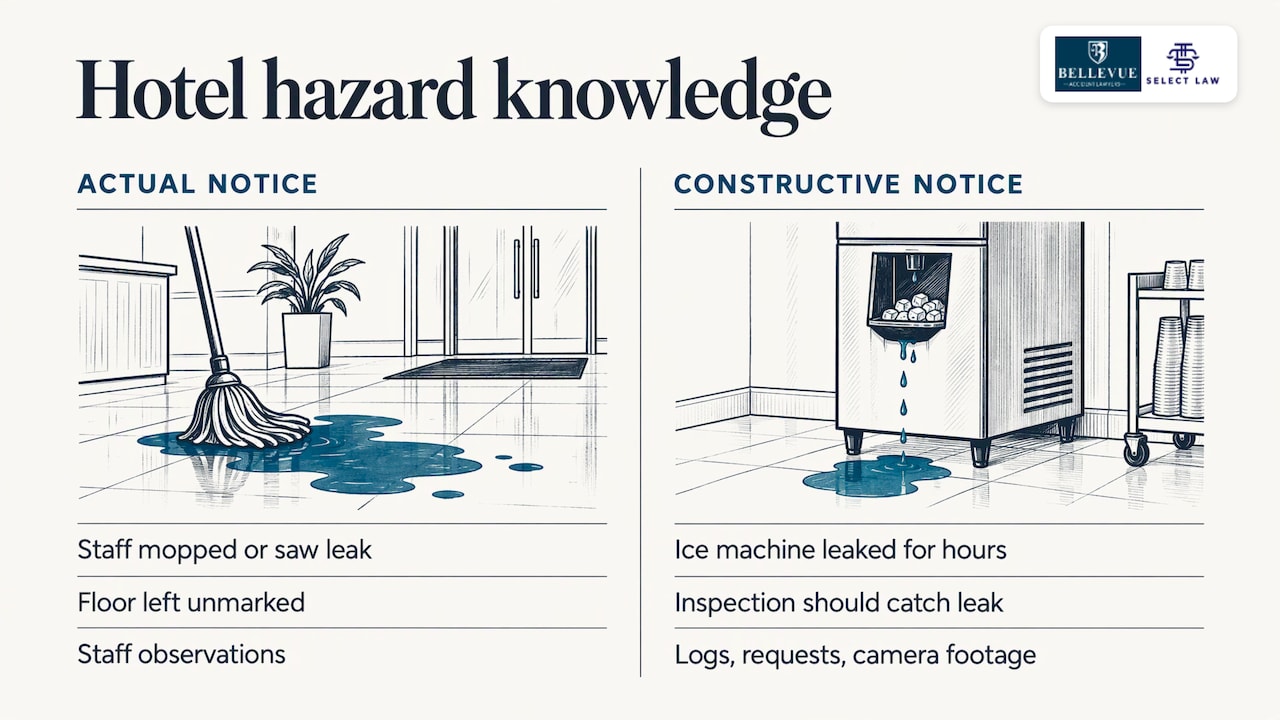
Suppose you slip on a wet lobby floor at 7 a.m. and break your wrist. There was no “wet floor” sign. Two questions decide the claim. Did a staff member mop it, or see it leak, and leave it unmarked? That is actual knowledge. Or had the leak from a broken ice machine been dripping for hours, so that a reasonable inspection would have caught it? That is constructive knowledge. Housekeeping logs, maintenance requests and camera footage are how those questions get answered, and a guest cannot obtain them without legal process.
Courts look at concrete proof. In Forde v. Concho Corporation (D.P.R., January 2025), the court denied summary judgment because there was a genuine dispute over whether a hammock’s height, uneven sloping ground and weak lighting created a foreseeable hazard. The evidence it described included guest testimony, photographs and an engineering expert’s analysis. The Ninth Circuit’s Petrey opinion adds that prior similar incidents are relevant to whether a hotel knew a condition was dangerous, but are not the only permissible proof, and that expert opinions grounded in evidence can create a real factual dispute.
Here is what to gather, in order of urgency:
Two cautions. Do not give a recorded statement to the hotel’s insurer before you understand your rights, and do not post about the incident on social media. For the broader steps after a fall on someone else’s property, see our guide on what to do after a slip and fall.
Hotels often hold video that is overwritten on a schedule. Evidence like that is why contacting an attorney early tends to protect a claim: a lawyer can send a written request to preserve footage, logs and maintenance records before they disappear.
Tort law, the body of civil law that lets injured people seek compensation from those who wronged them, varies by state. Compensatory damages typically equal the monetary value of lost earnings, lost future earning capacity, pain and suffering and reasonable medical expenses. Courts may also award punitive damages in certain cases to deter future misconduct, though compensatory damages are what most cases involve.
Federal model jury instructions list the kinds of loss a jury may consider, to the extent proved and caused by the defendant’s wrongful conduct:
| Category | Examples |
|---|---|
| Medical | Past and reasonable future treatment, therapy, necessary nonmedical expenses |
| Income | Lost earnings and reduced future earning capacity |
| Physical harm | Bodily injury, disability, disfigurement |
| Personal | Past and future pain, emotional distress, loss of enjoyment of life |
The same instructions state that compensatory damages should fairly compensate for proven losses, not punish and not cover speculative injury. A second set of federal jury instructions lists the nature, extent and permanence of the injury, scarring, medical care received and reasonably probable future care, and lost income among the factors a jury may weigh. In other words, documentation drives value: the more clearly your records connect the hotel’s failure to each loss, the more clearly each loss can be claimed. If scarring or a head injury is involved, those are areas we handle directly.
There is no single national hotel injury law. Each state sets its own deadlines, fault rules and standards of care, and the differences are real.
Because rules change, confirm the current deadline for your state with an attorney in the first weeks, not the last.
Sometimes a defective item hurt you, such as a faulty hair dryer or a collapsing chair. In Peterson, the California court explained that hotel owners are not strictly liable as product sellers just because a guest is hurt by a premises defect, while a separate product claim may remain against the manufacturer, distributor or retailer. A lawyer can sort out which defendants belong in your claim.
Hotels and their insurers have risk managers and claims adjusters. You have a medical recovery to manage. The gap between those two sides is the reason to hire counsel.
An attorney’s work on a hotel claim typically follows this path:
Along the way, your own conduct after the injury also matters. See our explanation of mitigation of damages, the duty to take reasonable steps to limit your losses, such as following medical advice.
For more on how these claims work, our attorneys explain premises liability claims and the most common types of premises liability cases in plain terms.
A hotel invites you in, charges you for the stay and controls the building. When a guest is hurt by something the hotel could have fixed, the cost should not fall on the guest.
We built Select Law around two commitments. First, you deal directly with an attorney and get personal attention, not a hand-off down a chain of staff. Second, you owe no fee unless compensation is won, so financial worry does not keep you from pursuing a claim while you heal.
Injury claims are won on specifics: the exact hazard, what the hotel knew, and records that tie the injury to the failure. We approach each case that way, and we explain each step in plain language so you know where your claim stands.
select
If you were hurt at a hotel, resort or similar property, our attorneys can review what happened and explain your options. We have offices in Bellevue, WA, Scottsdale, AZ and Lake Oswego, OR, and the consultation and case evaluation are free. You pay no fee unless we win.
Start with a free personal injury case evaluation, or see everything we handle on the Select Law home page.
Yes, if your injury resulted from the hotel’s failure to use reasonable care. You generally need to show the hotel knew or should have known about the danger and that the danger caused your injury. Hotels are not liable for every accident, so the specific facts decide the case.
Get medical care first. Then photograph the hazard, report the incident to hotel management and ask for a copy of the report, and collect witness contact details. Avoid giving a recorded statement to an insurer until you have spoken with an attorney.
At Select Law, consultations and case evaluations are free, and we work on a no fee unless we win basis. That means you owe attorney fees only if compensation is recovered for you.
The deadline depends on the state where you were hurt, and it can be shorter if the property is government-owned. Because missing it can end your claim, contact an attorney as soon as you can after the injury.
Hit by a car as a pedestrian? Learn what a pedestrian accident lawyer does, how fault and fees…
Read more
How to choose a Portland personal injury attorney: Oregon deadlines, contingency fee rules, what to ask at a…
Read more
Quick Answer Most personal injury lawyers in Bellevue charge nothing up front. They work on a contingency fee:…
Read more
Parham Hakimi is the founder of Select Law. Parham is passionate
about helping clients get a fresh start and victims who have
been wronged by the acts of others... Read more


