

Finding a Personal Injury Attorney Near Bellevue Square
Quick Answer Bellevue Accident Lawyers is a personal injury firm about a mile northeast of Bellevue Square, at…
Read moreCall For A Free Consultation
Menu
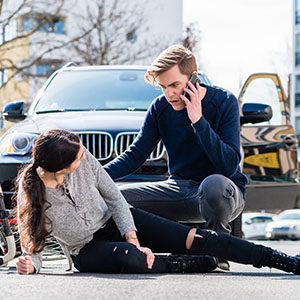
Quick answer: Get medical care first, and make sure the crash is reported to police. Oregon drivers must stop and stay stopped for pedestrians in marked and unmarked crosswalks (ORS 811.028). If you or someone you live with has car insurance, that policy’s Personal Injury Protection (PIP) usually pays your first medical bills, even though you were on foot. Don’t negotiate with the driver yourself, and keep the two-year filing deadline in mind.
Being hit while crossing the street is frightening, and the questions start quickly: should you call the driver, who pays the hospital, and does it matter that you stepped off the curb a second early? Here’s how Oregon law answers them.
At the scene, the driver is legally required to stop, stay, give you their name, address, vehicle registration and insurance details, and help get you medical care if needed (ORS 811.705). A driver who leaves an injury crash commits a felony.
After the scene, it’s usually better not to contact the driver directly. Talking about who was at fault, apologizing, or agreeing on “what happened” can be used later to argue you share the blame. If you’re missing their insurance information, get it through the police report or your own insurer. Expect a call from the driver’s insurance company. You can give your name and basic facts, but you don’t have to give a recorded statement, and it’s wise not to until you know the full extent of your injuries.
Every intersection has a crosswalk, even without paint. Under ORS 801.220, where no crosswalk is marked, the crosswalk is the part of the road at an intersection that connects the sidewalks or shoulders on each side. So a pedestrian crossing at an ordinary corner is usually in a legal crosswalk.
Drivers must stop and remain stopped when a pedestrian is in the crosswalk and in any of these places (ORS 811.028):
| Where the pedestrian is | Driver must stop and remain stopped? |
|---|---|
| In the driver’s lane | Yes |
| In a lane next to the driver’s lane | Yes |
| In the lane the driver is turning into | Yes |
| Turning at an intersection with a pedestrian signal: within 6 feet of the lane the driver is turning into | Yes |
| Turning at an intersection without a pedestrian signal: in the lane next to the one the driver is turning into | Yes |
A pedestrian counts as crossing as soon as any part of them, or their cane, wheelchair or crutch, moves onto the crosswalk with the intent to cross.
Pedestrians have duties too. You may not suddenly leave the curb and walk into the path of a car that is too close to stop, and outside a crosswalk you must yield to traffic (ORS 814.040).
In Oregon, a driver who hits a pedestrian in a crosswalk can face consequences on three fronts:
Separately from any ticket, the driver can be held financially responsible for your injuries through a civil claim, which in practice is paid by their liability insurer. A citation isn’t required for that claim, and paying a ticket doesn’t settle it.
Oregon auto policies must include PIP, with at least $15,000 for medical expenses (ORS 742.524). PIP pays regardless of who caused the crash. For a pedestrian, which policy pays depends on your household:
| Your situation | Whose PIP applies |
|---|---|
| You, or a family member you live with, has an Oregon auto policy | Your own policy covers you as a pedestrian hit by any vehicle, and it pays first. The driver’s PIP is excess (ORS 742.520, 742.526) |
| No one in your household has auto insurance | The driver’s PIP covers pedestrians struck by the insured vehicle (ORS 742.520) |
Policies have some exclusions, so read the declarations page or ask the insurer to confirm in writing. PIP covers early medical bills and part of lost income. Everything else, including pain and suffering, comes from the driver’s liability insurance through an injury claim. For more on how auto policies pay injury bills, see our guide to medical payments coverage.
You can still recover. Under ORS 31.600, an injured person can recover damages as long as their share of fault is not greater than the combined fault of the others responsible, and the damages are reduced by their percentage.
For example, if you’re found 20% at fault for stepping out late, your damages are reduced by 20%. If you’re found more at fault than the driver, you recover nothing. That’s why evidence about the signal, the driver’s speed and what the driver could see matters so much in pedestrian accident claims.
Your own uninsured motorist coverage may apply even though you were walking, so check your policy and tell your insurer quickly. For a hit-and-run, report it to police right away and keep the report number; your insurer will likely ask for it.
Evidence fades long before these deadlines, so it’s best not to wait. Read more about filing deadlines for injury claims.
No reliable average exists, and any figure quoted without your facts is a guess. What drives the value of a pedestrian claim is the seriousness and permanence of the injury, total medical bills and future care, lost income, how clearly the driver was at fault, and how much insurance is available.
Yes. Oregon treats the area connecting the sidewalks at an intersection as a crosswalk even without paint (ORS 801.220), and the stop-and-remain-stopped rule applies to it (ORS 811.028).
Usually, yes. If you or a family member you live with has an Oregon auto policy, its PIP covers you as a pedestrian and pays before the driver’s PIP.
You’re not required to. Give basic facts if you choose, and hold off on a recorded statement until you understand your injuries or have spoken with a lawyer.
You may still have a claim. Outside a crosswalk, you must yield to traffic, but a careless driver can still be mostly responsible, and Oregon’s comparative fault rule decides how much you can recover.
Generally two years to file a lawsuit, and only 180 days to give notice if a public body is involved.
If you were hit in a crosswalk in Lake Oswego or elsewhere in the Portland area, Select Law’s Lake Oswego office can review the police report, sort out which PIP and liability policies apply, and deal with the insurers while you recover. Consultations are free, and pedestrian injury cases are handled on contingency. Call (503) 495-5090 or visit us at 525 3rd St, Lake Oswego.
This article is general information about Oregon law, not legal advice for your situation.
Quick Answer Bellevue Accident Lawyers is a personal injury firm about a mile northeast of Bellevue Square, at…
Read more
Personal injury damages are not just limited to medical bills, wage loss and pain and suffering. An accident…
Read more
Wage loss in a personal injury case is a viable claim. It takes much more than missing work,…
Read more
Parham Hakimi is the founder of Select Law. Parham is passionate
about helping clients get a fresh start and victims who have
been wronged by the acts of others... Read more


